
-
Home

-
Article Topics
- Life
Life

Thoughts and insights about life. Philosophy. Sociology. Politics. How to live life and get the most out of it.
- Details
- Written by John Button
- Category: Life
- Hits: 940
Is it possible we've reached a limit on the extreme focus on the individual in America? By this I mean the supremacy of the individual's rights with little regard for the group. I hope we have reached some limit.
Read more: Has the age of the autonomous individual reached its peak?
- Details
- Written by John Button
- Category: Life
- Hits: 926
Taxes are a tough topic. For some time now, many have espoused a philosophy that lower taxes are always better. It is time to re-evaluate that viewpoint. We need to determine what level of tax is appropriate for the services we are receiving and collectively agree to pay it. The products and services we want must be paid for.
We have already received more than we acknowledge.
While no one, certainly including me, wishes to pay more than necessary I also understand that taxes have an appropriate role and purpose. The continuous desire to always reduce taxes seems to me to go together with a quintessential American pride in the self-made man notion. If you feel that you alone made whatever success you enjoy happen all on your own then you likely also feel that you don't owe a debt to the society in which you live. You'd be wrong in that assessment.
- Details
- Written by John Button
- Category: Life
- Hits: 2719
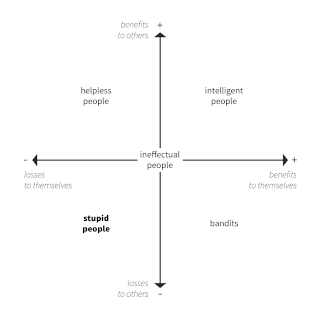
Written in 1976 by Carlo M. Cipolla his essay on stupid people, defined as those that by their actions cause losses to others without benefiting themselves, asserts that as a group they are the most powerful force. Beyond evil doers such as organized crime.
He provides the following structure to group people by their impact on themselves and others.
- Details
- Written by John Button
- Category: Life
- Hits: 1553
Rabbi Elliot Kukla1 once described a woman with a brain injury who would sometimes fall to the floor. People around her would rush to immediately get her back on her feet, before she was quite ready. She told Kukla,
I think people rush to help me up because they are so uncomfortable with seeing an adult lying on the floor. But what I really need is for someone to get down on the ground with me.
A reminder to me for the next time I see someone in physical or emotional distress. Rather than acting on impulse driven primarily by what makes me feel better, pause to consider what will make them feel most comfortable, then do it.
1 Elliot Kukla is the first openly transgender person to be ordained by the Reform Jewish seminary Hebrew Union College-Jewish Institute of Religion in Los Angeles.↵
- Details
- Written by John Button
- Category: Life
- Hits: 2229
Taken from a circular letter, addressing many topics, written to three friends and co-workers in the conspiracy against Hitler, on the tenth anniversary of Hitler’s accession to the chancellorship of Germany (note: emphasis added)…
Stupidity is a more dangerous enemy of the good than malice. One may protest against evil; it can be exposed and, if need be, prevented by use of force. Evil always carries within itself the germ of its own subversion in that it leaves behind in human beings at least a sense of unease. Against stupidity we are defenseless. Neither protests nor the use of force accomplish anything here; reasons fall on deaf ears; facts that contradict one’s prejudgment simply need not be believed – in such moments the stupid person even becomes critical – and when facts are irrefutable they are just pushed aside as inconsequential, as incidental. In all this the stupid person, in contrast to the malicious one, is utterly self-satisfied and, being easily irritated, becomes dangerous by going on the attack. For that reason, greater caution is called for than with a malicious one. Never again will we try to persuade the stupid person with reasons, for it is senseless and dangerous.
- Details
- Written by John Button
- Category: Life
- Hits: 4284
The proper function of man is to live, not to exist. I shall not waste my days in trying to prolong them. I shall use my time.
Jack London
- Details
- Written by John Button
- Category: Life
- Hits: 2937

TACAMO stands for "Take Charge and Move Out", a phase often used in the military and particularly by the Marines. But in the context of U.S. military aircraft, the phrase refers to a special mission and a similarly unique aircraft equipped to perform the mission. Years ago I worked on it but could not talk about it.
- Details
- Written by John Button
- Category: Life
- Hits: 7541
Most people have at least heard of the story of the good Samaritan. Maybe we've only heard, "be a good Samaritan," in reference to helping someone in a broken down car alongside a roadway1. Likely fewer know that the story is from the Bible. Specifically from the Gospel of Luke. It is a parable (a.k.a. a story used to illustrate a moral or spiritual lesson) told by Jesus as an illustration. And, what was the point of the story? What did Jesus intend for us to learn from it?
First, here's the story from the King James Bible (highlights added):
- Details
- Written by John Button
- Category: Life
- Hits: 2299
Tampa Bay Times - Letters to the Editor
23 Sept 2021
Dead right
Florida’s new surgeon general, Dr. Joseph Ladapo*, is spot-on with his observation that the best form of prevention from COVID-19 is for persons to have an infection because this will provide the best immunity. I am aware that he is correct because of a recent experience with a member of my family. He had a severe infection from COVID-19. He is past that now and is completely immune—not only for COVID-19 but flu and other respiratory infections as well. Dr. Ladapo’s recommendation works. Of course we are burying this family member next week.
Charles Chamberlain, Spring Hill
We have seen that like most vaccines, the COVID-19 ones attempt to avoid any infection but the more important service to lessen the impact of an infection to avoid death. I would suggest we not measure the effectiveness of this or any other vaccine only by lack of any infection but the cumulative reduction in the impact. At least for me, I can literally live with an influenza or other infection as long as it does not kill me.
* The surgeon general has commented that a previous coronavirus infection “protects people from getting very ill and also protects people from being infected again.”↩
- Details
- Written by John Button
- Category: Life
- Hits: 2316
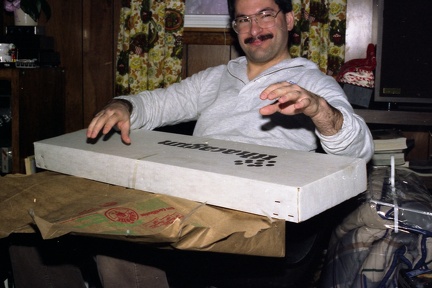
Back in the mid-1980's (maybe 1984?) my brother-in-law gifted me for Christmas a new Ithaca shotgun. I've kept it—unfired—all these years. Not only is it a classic example of a very popular gun from that area and time but also a representation of my family. Both my father and grandfather worked at Ithaca Gun.
Page 2 of 4
-
Home
-
Article Topics
- Life